Why fuel cost per job is worth knowing
Most service businesses know their fuel bill for the month. Far fewer know what fuel costs for a single job. That number matters for three reasons:
- Pricing. If a call-out fee doesn't cover the fuel to get there, far-away jobs quietly lose money.
- Planning. It shows what a badly ordered day actually costs.
- Price swings. When pump prices jump, you can see exactly how much it affects each job, rather than guessing.
The basic sum
For any stretch of driving:
Fuel cost = miles ÷ miles per gallon × price per gallon
The catch is that a vehicle doesn't get one mileage figure. Stop-start driving in town uses far more fuel per mile than steady driving on a highway. The U.S. government's fueleconomy.gov lists separate city and highway figures for most vehicle models, and that split makes your numbers much more accurate.
A worked example
Say a technician drives a vehicle rated at 15 mpg in the city and 20 mpg on the highway, and fuel costs $3.50 a gallon. Their day has 6 jobs: 40 miles of town driving and 30 miles on the highway.
- City: 40 ÷ 15 = 2.67 gallons × $3.50 = $9.33
- Highway: 30 ÷ 20 = 1.5 gallons × $3.50 = $5.25
- Day total: $14.58
- Per job: $14.58 ÷ 6 = $2.43
If you had used one blended figure of 17 mpg for the whole day, you would get $14.41. That looks close, but on days with more town driving the gap grows, and it hides where the fuel actually goes.
Fuel per job on our sample day
Here is the same sum on the sample day we use in our demo: 12 service stops around Denver with 2 vehicles.
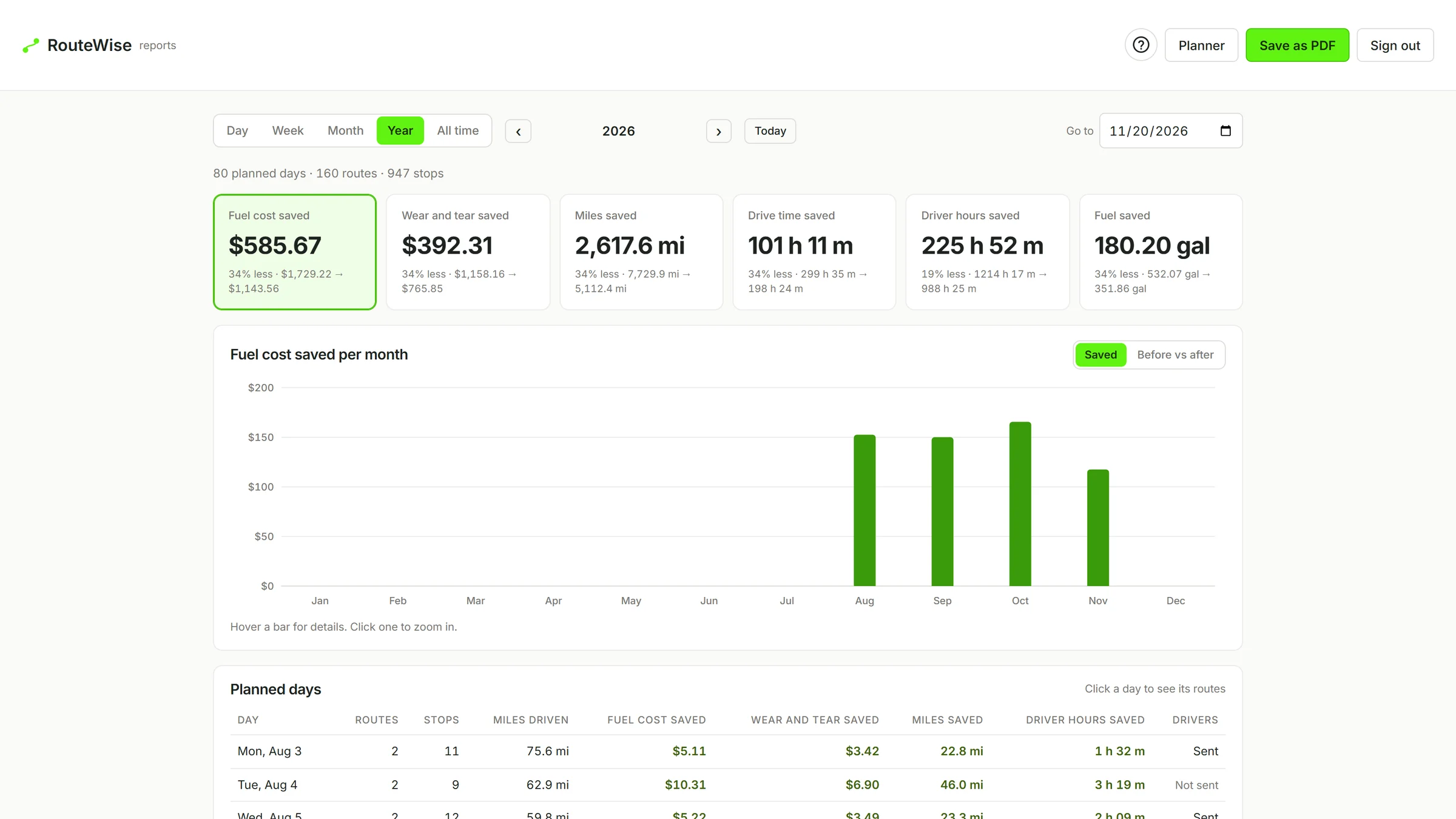
With the stops split evenly between the vehicles, the day came to 105.9 miles and $20.39 of fuel, or about $1.70 a job. Planned with RouteWise, the same 12 stops took 61.1 miles and $11.37 of fuel, about $0.95 a job. Fuel prices and vehicles didn't change. Only the route order and which vehicle took each stop did.
That is one sample day, not a promise, and your own days will be different. It does show where the money usually is: in the miles, not in the price at the pump.
Where the savings usually hide
Backtracking. A route that crosses town twice is the most common cause of wasted miles. Ordering stops as a loop fixes most of it.
The wrong vehicle on the job. If a heavier vehicle with poor mileage takes the long highway run while a lighter one does short hops, swapping them can save fuel without changing a single stop.
Habit areas. "Mike always does the north side" is easy, but it means nobody checks whether the north side should be split differently today.
Late starts. A driver who leaves early and waits outside a 10:00 appointment burns time, and often fuel too. Let them leave later.
What to leave out (and keep separate)
Fuel cost is easiest to trust when it's only fuel. Wear and tear, tires and servicing also go up with miles, but they are harder to pin down. Keep them as a separate cost per mile rather than mixing them into fuel. RouteWise works this way: fuel is worked out leg by leg from each vehicle's own city and highway mileage and your fuel price, and any wear-and-tear cost per mile is shown on its own line.
Driver wages are separate again. Fewer miles usually means fewer hours too, which is covered in our article on winning back technician hours.
Questions and answers
How do I calculate fuel cost per job?
Work out the fuel for the day's driving (miles divided by miles per gallon, times the price per gallon), then divide by the number of jobs that day. For better accuracy, use city mileage for town driving and highway mileage for highway driving.
Should I use city or highway mpg for service vehicles?
Use both. Most service driving mixes slow town legs and faster highway legs. Applying the city figure to slow legs and the highway figure to fast ones gives a more accurate total than a single average.
Where can I find my vehicle's real mpg?
The U.S. government's fueleconomy.gov site lists city and highway ratings for most vehicle models. Compare them with your fuel card statements: if real spending is much higher, idling and heavy loads are the usual reasons.
Does better route planning really cut fuel costs?
It usually does, because the biggest fuel cost is miles driven. On our 12-stop sample day, better route order and job sharing cut fuel from $20.39 to $11.37 with the same vehicles and fuel price. Results depend on your own routes.
Should wear and tear be included in fuel cost per job?
Keep it separate. Fuel is easy to calculate and check against receipts, while wear and tear is an estimate. Showing them as separate costs per mile keeps each number honest and easy to compare.